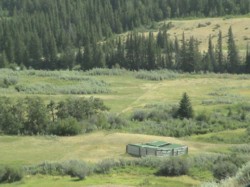
Cyprus Hill
John Evans was in a foul mood. So was his gang of Green River Renegades.
Their horses had been stolen, presumably by Indians, and someone was going to
pay! Trailing the supposed thieves, they entered Canada in what is known today
as the province of Saskatchewan, and ended up a few kilometers from Fort
Farwell, a whiskey trading post. Here the trail suddenly went cold.
John Evans and his gang were renowned wolfers, killing packs of wolves for their
lucrative hides by attracting them to poisoned buffalo carcasses. Now they were
looking for revenge and were blaming Indians for all of their woes.
The wolfers decided to stay at Fort Farwell for the night. Sleep was far from
their mind however, and thoughts of vengeance, enhanced by alcohol, would keep
them up until morning. Meanwhile they acquired the information from the
proprietor, Abel Farwell, that there was a group of Assiniboines Indians camping
just upriver.
During their drunken stupor, the wolvers met a trader by the name of George
Hammond who was blaming the Assiniboines for the recent theft of his horse. He
claimed that some Indian had claimed a reward for returning his mount, "probably
the one who stole my horse in the first place." He had paid him with a bottle of
whiskey, but continued to blame the Indian for the horse theft.
Early in the morning George Hammond found out that his horse was again missing.
The Green River Renegades decided it was time for revenge. They climbed on their
horses and off they went, heading for the Assiniboine camp. They had barely left
Fort Farwell that someone found George Hammond's horse. It had simply wandered
away looking for greener pastures, but the wolvers wouldn't be deterred.
The confrontation between chief Little Soldier and John Evans did not go well.
The Indians had been drinking whiskey all through the night as well. The whiskey
was far from being pure. It was diluted with water, mixed with tobacco juice for
colour, and then laudanum, an opium substance, was added, along with Jamaican
ginger or pepper to cause a throat-burning effect. By diluting the whiskey, more
profits could be made. Nevertheless, it was enough to make any man sick, and
most of the Indians were addicted to it.
The wolfers opened fired and succeeded in butchering thirty Assiniboines, thanks
to their high-powered rifles. Only one of the wolfers, Ed Grace, died of an
arrow in his chest. Still enraged, the wolfers cut off the chief's head, mounted
it on a pole, and paraded it through the plundered camp as a warning to other
natives. Although no horses were found in the camp, other than a few small
ponies, the Green River Renegades returned to the United States, boasting of
their kill.
News of the Cyprus Hill massacre reached the Prime Minister of Canada, John A.
Macdonald. His whole cabinet was shocked, and fear of Indian reprisals was high.
Canada did not want to end up with the same types of Indian wars that were being
fought at the time in the United States. In addition there was concern over the
fact that alcohol was ruining the lives of the native populations in the west,
and Macdonald also feared losing the western Canadian territories to the
Americans. A police presence had to be established in the West, and the
North-West Mounted Rifles, renamed the North-West Mounted Police a few months
later, was established. This police force had an amazing impact on Western
Canada. Natives were again safe. Alcohol was banned, and some of the men of the
Green River Renegades were brought to court. Due to insufficient evidence
however, the cases were dismissed.
It is amazing how sin can quickly develop into a blazing fire. Blaming others
can lead to revenge. The desire for revenge can lead to murder, and the worst of
all the consequences of murder, it leads to boasting. Clear logic seems hampered
where sin reigns. One action leads to another, and before we know it, we are
facing the consequences of a huge disaster. Families are broken up, addictions
are developed, jobs are lost and loneliness ends up in despair.
"When tempted, no one should say, 'God is tempting me.' For God cannot be
tempted by evil, nor does he tempt anyone; but each one is tempted when, by his
own evil desire, he is dragged away and enticed. Then, after desire has
conceived, it gives birth to sin; and sin, when it is full-grown, gives birth to
death." (James 1:13-15 NIV)
James' advices: "Therefore, get rid of all moral filth and the evil that is so
prevalent and humbly accept the word planted in you, which can save you." (James
1:21 NIV)
"Who stole my horse?"
Instead of blaming others, isn't it time we own up to our own actions?
Rob Chaffart
The Illustrator: This daily newsletter is dedicated to encouraging
everyone to look towards Jesus as the source of all the solutions to our
problems. It contains a daily inspirational story, a Bible verse and encouraging
messages. HTML and plain text versions available.
The Nugget: Published three times a week, this newsletter features inspirational devotionals and mini-sermons dedicated to drawing mankind closer to each other and to Christ.