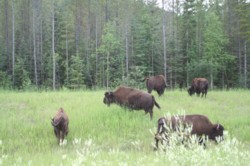
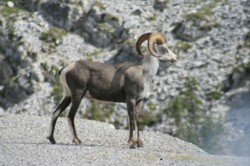
Fascinating wildlife on the Alaska Highway
"For since the creation of the
world God's invisible qualities-his eternal power and divine nature-have been
clearly seen, being understood from what has been made, so that men are without
excuse." (Rom 1:20 NIV)
I am staring right now at a bumper sticker. Word for
word, spelling error included, it says in bold letters: "I Drove the Alaska
Hiway … and lived!" The bumper sticker then shows a picture of a man in very bad
shape, with torn clothing and bandages wound around his head, standing beside a
car that seems to have faired even worse. Can the Alaska Highway really be that
bad? After all, we had already driven part of it, and we weren't in bad shape...
But then, we didn't drive the original, 1523 mile-long
highway, the one that was built in less than nine months...
Let's just imagine standing out in the wilderness in
1942, watching the construction crews struggle to meet their impossible
deadlines. Remember to keep your distance, or you might be at risk of becoming
unidentified road kill!
The first group to be on the watch for is the
surveyors. Remember, it's 1942 and there are no detailed topographic maps or
GPSs. These workers have to rely solely on the sparse information provided by
the Canadian Department of Transportation and by the First Nations guides. As a
result, much of their surveying goes like this: One of the surveyors climbs up a
tree (or if he is tired, he will forego the better view for the easier climb and
crawl onto a piece of equipment instead). He will then choose an object in the
distance, and the crew will work towards it. Everything is done to avoid major
obstacles, but as this isn't always possible, creativity is often necessary!
If you are managing to stay out of the way of the tree
the surveyors are climbing, you can then stick around to watch for the three
bulldozers that follow the line that the surveyors blaze. The first bulldozer
goes straight down the centre line, destroying anything in its path (Watch out
for your toes!). The next two follow after the first, clearing a road-width
swatch through the forest.
Smaller bulldozers follow the large ones. If you've
ever had the "privilege" of having three large bulldozers cross your yard, you
will understand the job of the smaller machines: To clean up the mess left by
the larger ones!
Behind these miniature dozers, other units follow
suite. Their purpose is to build culverts and ditches, and temporary bridges
that they know will wash away in the Spring. Sometimes they deem it necessary to
lay a bed of logs on the rough ground, with the purpose of keeping the road from
sinking into boggy, wet marshes. Yuck!
Forty-eight to 64 kms behind these units, the largest
unit follows, the Engineering Unit. Its task is to create a plausible road
surface that will sustain military transportation. Scrapers, loaders and trucks
are used to widen and straighten the road as much as possible. They reroute some
of the steepest grades and cover the surface with gravel . . .
Are you starting to get the picture? The original
Alaska Highway wasn't a fun road to drive! Definitely not one you would choose
for a leisurely Sunday afternoon drive! It isn't any wonder that in 1958 (16
years after this highway was built), the American Automobile Association
recommended that anyone travelling this highway bring the following items: "Two
mounted spare tires (preferably six-ply or nylon) and tubes, fuel pump, spark
plugs, fan belt, light fuses, cold-patch tube repair kit and pump, car tools, a
fire extinguisher, tow rope or cable, and an extra coil and condenser."
In all reality, the road really isn't all that bad
anymore. It does have the tendency to go up and down and to twist and turn, and
it is true that people can literally become seasick while driving this
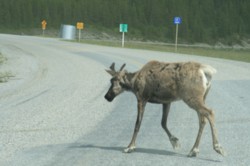
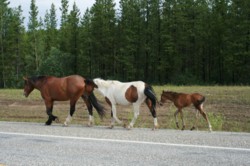
fascinating highway. But the view, as well as the many wildlife encounters (free
roaming bison, mountain goats, horses, elk, deer, bear, moose, and even eagles),
make every curve and every climb well worth the effort. As we twisted and turned
along the Highway ourselves, we couldn't help but thank God for His beautiful
creation. Wow! God sure knows how to make masterpieces!
In life, we are always faced with the choice of either
thanking God for the beauty of His creation or of focusing on the negative. In a
world fallen to sin, we can not expect perfection. This will only come when we
meet Jesus face to face. I mean, just imagine: "There will be no more death or
mourning or crying or pain, for the old order of things has passed away." (Rev.
21:4 NIV)
In the meantime let's focus on the positive, on the
beauty that God has surrounded us with. Wow! We can't help but fall on our knees
and adore our Lord and Creator!
"Nor should there be obscenity, foolish talk or coarse
joking, which are out of place, but rather thanksgiving." (Eph 5:4 NIV)
"For everything God created is good, and nothing is to
be rejected if it is received with thanksgiving." (1 Tim 4:4 NIV)
Will you join me in my trek through the Yukon? Don't
forget to pack those two mounted spare tires and the extra spark plugs! But most
of all, be prepared to stand in awe in front of our Creator, who cares and loves
each one of us!
Rob Chaffart
The Illustrator: This daily newsletter is dedicated to encouraging
everyone to look towards Jesus as the source of all the solutions to our
problems. It contains a daily inspirational story, a Bible verse and encouraging
messages. HTML and plain text versions available.
The Nugget: Published three times a week, this newsletter features inspirational devotionals and mini-sermons dedicated to drawing mankind closer to each other and to Christ.