
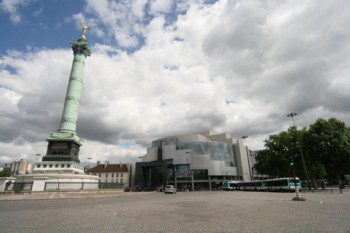
Remains from the Bastille La Place de Bastille where the Bastille once stood.
Introduction: This new series, which is inspired by our short visit to Paris
this summer, is based on Romans 8. La Vie en Rose was first sung by Edith Piaf
in 1946. It soon became so popular that the expression "La Vie en Rose", meaning
"Life without worry", has become synonymous with the French way of life. Of
course a life without worry is not realistic, but we, as Christians, have access
to a real "Vie en Rose" through Jesus. Jesus made us "more than conquerors" for
a reason, and it was not so that we could to cower in a corner, ashamed of our
addictions. Instead, it is to deliver us from evil so that we can enjoy real
living. He is our Vie en Rose!
La Bastille.
Though the building no longer exists, it is still well-known throughout the
world. The Bastille was built between 1370 and 1380, and it was originally known
as the Chastel Saint-Antoine. It was initially used as a fortress to provide
protection against the Anglo-Burgundian forces during the Hundred Years' War.
Early in the 17th Century, however, Cardinal Richelieu decided to transform it
into a prison, first for the upper class, and later on, for more run-of-the-mill
criminals.
The lettre de cachet, an arbitrary royal warrant arrest, threw innocent people
into the horrors of the Bastille, rendering this fortress as one of the darkest
symbols of royal despotism. Although there were worse prisons in France, the
incarceration conditions in the Bastille were far from desirable. Anyone who
spent even a half a minute thinking about them was filled with revulsion.
Sleeping with rats on damp straw, exposure to extreme cold, and rations of dry
bread and water were common occurrences at the Bastille. A prisoner by the name
of Constantine de Renneville wrote: ""Under an opening in the wall, I saw human
bones; it was like a cemetery, and since I found the cellar in parts without
paving, I dug and found a corpse wrapped in rags ... the warder said that they
had kept the sorry remains in his cell; two other men and one woman had suffered
the same fate." (Lüsebrink, 11) No wonder the French revolted against such a
repugnant symbol of tyranny.
In the morning of July 14, 1789, the people of Paris seized weapons from the
armoury at the Invalides and stormed the Bastille, releasing its seven prisoners
and tearing it completely down. All that now remains of this infamous structure
are a few bricks in a park near the "Place de la Bastille". The people of Paris
no longer need to tremble at the mere thought of being incarcerated without
reason in the horrible Bastille. There is no more condemnation to be found in
this horrid place! The seven released prisoners sure can vouch for that!
In a much broader topic, we, too, have been released from our certain horrid
destination. No one can claim to be sin free. All of us have been tainted by it,
some more than others. Unlike many of the Bastille prisoners, however, we are
actually guilty of our crimes! But God in His mercy send His son to die in our
place, a death He did not deserve! He died so that we could be set free from any
condemnation. He rose from the grave to assure us that we can indeed be freed
from any addictions as well.
Like the apostle Paul said, "Therefore, there is now no condemnation for those
who are in Christ Jesus." (Rom 8:1 NIV) If the French can celebrate their
liberation every 14th of July, we have even more reason to celebrate the
resurrection of our Lord! Hallelujah! We are truly free from condemnation!
Moreover God opened the gates wide for reconciliation with Him! Wow!
What are we waiting for? Let's celebrate! Let's run into the wide-open arms of
our Heavenly Father. He loves us! Now that we are in Christ, there is no more
condemnation!
Rob Chaffart
The Illustrator: This daily newsletter is dedicated to encouraging
everyone to look towards Jesus as the source of all the solutions to our
problems. It contains a daily inspirational story, a Bible verse and encouraging
messages. HTML and plain text versions available.
The Nugget: Published three times a week, this newsletter features inspirational devotionals and mini-sermons dedicated to drawing mankind closer to each other and to Christ.